 Add to Chrome
 Add to Firefox
 Add to Edge
MotionGrounder: Grounded Multi-Object Motion Transfer via Diffusion Transformer
Apr 01, 2026
Motion transfer enables controllable video generation by transferring temporal dynamics from a reference video to synthesize a new video conditioned on a target caption. However, existing Diffusion Transformer (DiT)-based methods are limited to single-object videos, restricting fine-grained control in real-world scenes with multiple objects. In this work, we introduce MotionGrounder, a DiT-based framework that firstly handles motion transfer with multi-object controllability. Our Flow-based Motion Signal (FMS) in MotionGrounder provides a stable motion prior for target video generation, while our Object-Caption Alignment Loss (OCAL) grounds object captions to their corresponding spatial regions. We further propose a new Object Grounding Score (OGS), which jointly evaluates (i) spatial alignment between source video objects and their generated counterparts and (ii) semantic consistency between each generated object and its target caption. Our experiments show that MotionGrounder consistently outperforms recent baselines across quantitative, qualitative, and human evaluations.

MIVE: New Design and Benchmark for Multi-Instance Video Editing
Dec 17, 2024
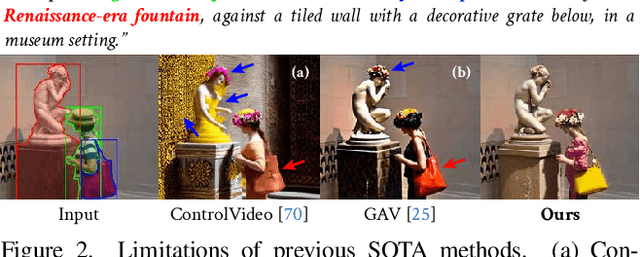
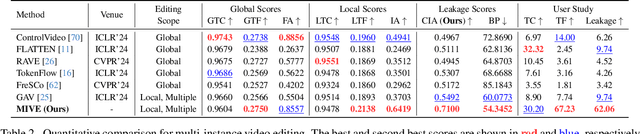
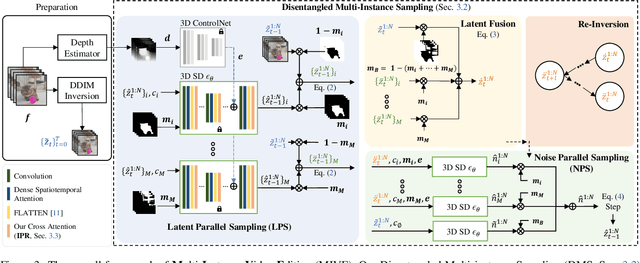
Recent AI-based video editing has enabled users to edit videos through simple text prompts, significantly simplifying the editing process. However, recent zero-shot video editing techniques primarily focus on global or single-object edits, which can lead to unintended changes in other parts of the video. When multiple objects require localized edits, existing methods face challenges, such as unfaithful editing, editing leakage, and lack of suitable evaluation datasets and metrics. To overcome these limitations, we propose a zero-shot $\textbf{M}$ulti-$\textbf{I}$nstance $\textbf{V}$ideo $\textbf{E}$diting framework, called MIVE. MIVE is a general-purpose mask-based framework, not dedicated to specific objects (e.g., people). MIVE introduces two key modules: (i) Disentangled Multi-instance Sampling (DMS) to prevent editing leakage and (ii) Instance-centric Probability Redistribution (IPR) to ensure precise localization and faithful editing. Additionally, we present our new MIVE Dataset featuring diverse video scenarios and introduce the Cross-Instance Accuracy (CIA) Score to evaluate editing leakage in multi-instance video editing tasks. Our extensive qualitative, quantitative, and user study evaluations demonstrate that MIVE significantly outperforms recent state-of-the-art methods in terms of editing faithfulness, accuracy, and leakage prevention, setting a new benchmark for multi-instance video editing. The project page is available at https://kaist-viclab.github.io/mive-site/